

What is a Rain Screen?
A rain screen is a continuous ventilated air gap (typically 3/8 to 3/4 inch) between the back of the siding and the housewrap on the wall behind it. The gap is created by thin vertical furring strips fastened over the housewrap before the siding goes on. Its job is to let any water that gets past the siding (wind-driven rain, capillary action at joints, condensation) drain straight down to the bottom of the wall and exit, while letting air circulate behind the siding so the assembly dries. It is the single biggest determinant of how long a siding job lasts in a humid climate like Virginia and Maryland.
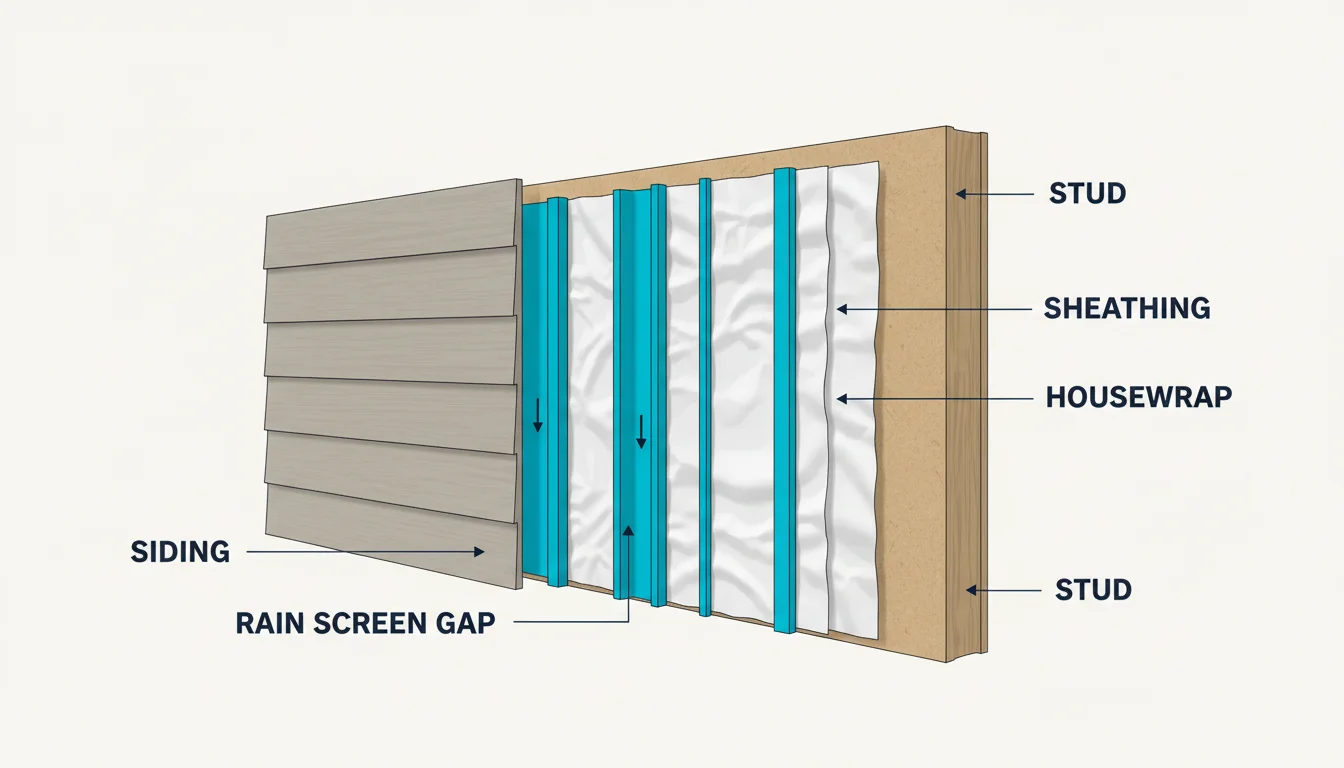
The cyan vertical strips are the furring strips that create the rain screen gap behind the siding. Any water that gets past the siding drains down through the cyan gap to exit at the bottom of the wall.
What is the purpose of a rain screen?
Three jobs. First, drainage: any water that gets past the siding face (during a wind-driven rain event, around a poorly sealed window, through a hairline gap at a joint) has a clear path down and out at the base of the wall. Without the rain screen gap, that water sits trapped against the back of the siding and the housewrap, eventually wicking into the wall sheathing.
Second, drying: the air circulating through the gap accelerates evaporation. Even if water gets in, the wall dries within hours or days instead of weeks. This is the single most important factor in long siding life span; siding fails when the back face stays wet too long.
Third, pressure equalization: a vented cavity reduces the pressure differential that pulls wind-driven rain through small openings in the first place. This is the structural physics behind why the system is called a “rain screen” rather than a “rain wall.”
Is Tyvek a rain screen?
No. Tyvek (and similar housewrap products like HomeWrap, WeatherSmart, etc.) is a weather-resistive barrier. It sits flat against the sheathing and is one layer of the wall assembly. By itself it provides no drainage gap.
Some textured products (e.g., Tyvek DrainWrap, HomeSlicker, Cedar Breather) create a small wrinkle or mesh thickness that gives water somewhere to run. These are usually called “minimal drainage” or “wrinkled-housewrap” rain screens and are a step up from flat housewrap, but they provide only about 1/16 to 1/8 inch of drainage space rather than the 3/8 inch a true furring-strip rain screen provides. For premium siding installs in our climate, the furring-strip rain screen is the gold standard.
What does a rain screen look like?
From the outside, you cannot see a rain screen at all. Once the siding is on, the wall looks completely normal; the gap is hidden behind the siding face. The only telltale signs are visible at the bottom of the wall (where the gap is intentionally left open to drain) and at the top under the soffit (where the gap vents).
If you peeled off a siding panel, you would see the rain screen as a series of vertical strips (the furring strips) running up the wall, fastened over the housewrap. Between the strips is an open vertical channel about 3/8 inch deep that runs uninterrupted from the bottom of the wall to the top, allowing water to drain and air to flow.
Do I need a rain screen?
In Virginia and Maryland, yes, on any premium siding install. Code does not strictly require it for every project (fiber cement, vinyl, and other claddings can technically be direct-attached to housewrap), but every major manufacturer’s best-practice install spec recommends or requires a drainage gap for the full product warranty. James Hardie HardiePlank, LP SmartSide, and most fiber cement manufacturers all publish drainage gap guidance.
The functional reason is the climate. Our mixed-humid climate sees heavy summer rain, occasional freeze-thaw winter, and high humidity from April through October. Walls that stay wet too long develop mold, rot, and siding failure. A 3/8 inch ventilated rain screen is the cheapest single upgrade that adds 10 to 20 years to the life of the siding job.
How much does it cost to install a rain screen?
Roughly 3 to 8 percent of the total siding install cost. On a 1,800 square foot ranch with a $25,000 siding install, the rain screen adds about $1,000 to $2,000 in materials (furring strips, fasteners) and a few hours of additional install labor. On larger or two-story homes the absolute number grows but the percentage stays about the same.
The math strongly favors including it. Skipping the rain screen saves a few percent up front; failing to dry the wall correctly shortens the siding life by a decade or more. The lifetime cost of skipping it is dramatically higher than the upfront cost of including it.
What DreamHome installs
DreamHome includes a 3/8 inch vertical furring-strip rain screen on every premium siding install (James Hardie and LP SmartSide) as a standard line item, never an upsell. The strips are pressure-treated lumber or molded plastic furring strips fastened over the housewrap into the wall studs at 16-inch spacing. The bottom of every cavity is left open to drain (a small bug screen prevents pests); the top vents at the soffit.
For vinyl siding installs (which often skip the rain screen at industry standard), DH offers the same furring-strip rain screen as an optional upgrade. We document the rain screen depth, strip material, and ventilation strategy on every work order so the homeowner can verify what was installed.
Red flags on someone else’s siding job
- Premium siding direct-attached to housewrap. Hardie or SmartSide installed flush against the Tyvek with no furring strips. The siding will fail 10 to 15 years earlier than spec in our climate.
- Bottom of the wall sealed shut with caulk or trim. Traps water inside the rain screen cavity. The bottom must be left open to drain (with a bug screen if pests are a concern).
- Furring strips installed horizontally. Blocks downward drainage. Strips must run vertically so water can fall straight down through the cavity.
- Strips fastened only to sheathing, not to studs. Eventually pulls out. Strips must hit studs to hold the weight of the siding long-term.
- “Wrinkled housewrap” called equivalent to a furring-strip rain screen. They are not equivalent. The wrinkled product is 1/8 inch at best; furring strips give 3/8 inch. The thicker the gap, the longer the wall stays dry.